 PropPilot.ai
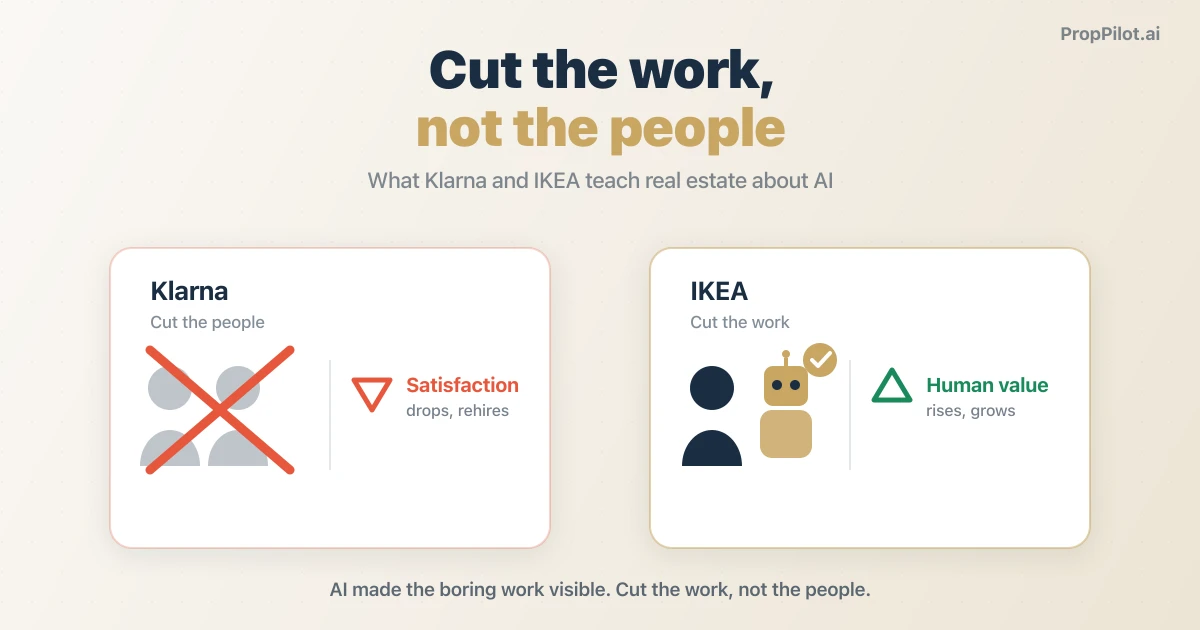
Two companies, two ways to use AI
In early 2024, Klarna proudly announced that its AI assistant was doing the work of 700 customer service agents. The message to the market was clear: AI lets you cut headcount. A year later, the story changed. Customer satisfaction suffered, and the company itself admitted it had cut too deep — bringing people back for customer-facing work.
In parallel, IKEA (through the Ingka Group) did the opposite. Starting in 2021 it deployed an AI assistant, Billie, that came to resolve on its own around 47% of customer service queries. But instead of laying people off, leadership looked at the remaining 53% and discovered something important: much of it wasn’t support — it was design and advisory conversations. So they retrained thousands of call-center agents as remote interior design consultants.
The comparison was popularized by product expert Jeff Gothelf, and his conclusion fits in one line:
“AI made the boring work visible. Cut the work, not the people.”
Why this matters for your brokerage
What AI really does isn’t “replace jobs.” It makes visible an uncomfortable truth: a huge slice of your team’s day goes to repetitive, low-judgment tasks.
Think about your agency. How many hours a week disappear into:
- Answering the first “is this still available?” from an Idealista or Zillow lead
- Asking the same three qualifying questions over and over (budget, area, property type)
- Forwarding listings, coordinating viewing times, reminding people of appointments
- Re-engaging cold leads nobody has had time to call back
None of that needs the judgment of an experienced agent. And yet it eats the hours that agent should be spending closing deals.
When AI makes that work visible, you have two paths. The Klarna path: “if AI does this, I need fewer people.” Or the IKEA path: “if AI does this, my people can finally focus on what actually moves the needle.”
The work that DOES require a human
In real estate, the line between what can be automated and what stays human is fairly sharp. AI is excellent at first contact and qualification. But some work — just like IKEA’s 53% — turns out to be the most valuable:
| What AI does best | What humans do best |
|---|---|
| Respond in under 5 minutes, 24/7 | Build trust during a viewing |
| Qualify with consistent questions | Read the buyer’s real hesitations |
| Schedule viewings and reminders | Negotiate price and terms |
| Re-engage cold leads at scale | Close the deal |
| Gather and summarize context | Advise on a life-changing purchase |
AI doesn’t compete with your best agent. It competes with the sticky note, the “I’ll call them later,” and the lead that goes cold in the inbox on a Saturday night.
Klarna’s mistake, translated to real estate
Klarna’s failure wasn’t adopting AI. It was confusing “this task can be automated” with “this person is redundant.” When you cut people but don’t redesign the work, the customer notices: colder responses, less ability to handle complexity, a worse experience.
In a brokerage, that same mistake would look like this: putting a bot in charge of “handling” everything — including what requires judgment — and leaving the buyer with no real human when it’s time to decide. The outcome would be the same as Klarna’s: falling satisfaction and a lost sale.
The IKEA model applied to your agency is exactly the opposite: AI filters and prepares; the human closes better than ever, because they walk into every conversation with the context already done and with time freed up from mechanical tasks.
What this looks like in practice
- The lead arrives from the portal, your website, or WhatsApp — at any hour.
- AI responds in seconds: greets, confirms interest, asks qualifying questions, and proposes viewing times.
- The agent receives a hot, context-rich lead: they already know budget, area, and urgency before the first call.
- The human does what they do best: advise, show, negotiate, and close.
The agent doesn’t work less. They work on what matters. And, just like at IKEA, that recovered time is where the real return lives: more viewings handled, more deals closed, a better experience for the buyer.
The question you should be asking
It’s not “should I use AI in my agency?” The market has already answered that. The question is how you’ll use it: the Klarna way, cutting and regretting it later? Or the IKEA way, freeing your team and growing?
The first step is knowing where your people’s time goes today. How long does your agency take to respond to a lead? How many hours go to tasks an AI could absorb this week?
Find out with data, not assumptions. Request a free Mystery Shopper and measure how your agency responds to a real lead today.
Frequently asked questions
Will AI replace real estate agents?
Not the good ones. AI automates repetitive, low-judgment work — answering the first message, qualifying, scheduling — but closing, viewings, negotiation, and building trust remain human. The winning strategy isn’t replacing people; it’s freeing their time for high-value work.
Why did Klarna have to rehire after automating with AI?
Klarna replaced part of its customer service with AI in 2024 chasing cost cuts. By 2025 customer satisfaction had dropped and the company publicly admitted it had gone too far, bringing human agents back. The mistake wasn’t using AI — it was using it to remove people instead of removing low-value work.
How do I apply the IKEA model in a real estate agency?
Let AI absorb first contact and lead qualification (the boring, repetitive work), and redirect your team toward what humans do best: advising buyers, running viewings, negotiating, and building relationships. Same principle: cut the low-judgment work, not the people.
Conclusion
AI isn’t an excuse to have fewer people. It’s an opportunity for your people to finally do the work that actually closes deals. Klarna learned the hard way; IKEA understood it in time. The difference wasn’t the technology — it was the decision.
At PropPilot we build AI agents with that philosophy: let them absorb first contact and qualification so your team spends its time selling. Want to see where your agency could start? Request a free Mystery Shopper and begin with data.
Sources: the Klarna/IKEA contrast was framed by Jeff Gothelf. Klarna’s reversal was reported by Fortune and acknowledged by its own CEO. IKEA’s figures come from Ingka Group public communications cited in Gothelf’s analysis.